
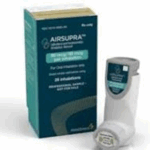
Budesonide and Albuterol - Medication Detail

budesonide and albuterolMedication Type:  Anti-Inflammatory Reliever (AIR); not recommended for everyday use

Generic Names:  Budesonide and Albuterol

Brand Name:  Airsupra® (albuterol 90 mcg/budesonide 80 mcg)

Description:  This medication is a combination of a short-acting beta-agonist (SABA) and an inhaled corticosteroid (ICS) so it causes the muscles around the airways to relax and helps bring down inflammation in the airways, opening them up for easier breathing. This medication is only approved for use in patients 18 years of age and older.

Delivery

MDI (metered dose inhaler)

Spacer

Airsupra can be used with a spacer.

Dosage

This medication is only approved for use in patients 18 years of age and older. 2 inhalations (puffs) as needed. Use Airsupra exactly as your healthcare provider tells you to use it. Do not take more than 6 doses (12 inhalations) in a 24-hour period.

Proper Use

  • See instructions for proper use.
  • Before first use or if inhaler has not been used for more than seven days, prepare inhaler by spraying 2 test sprays into the air away from face.
  • Refill when the puff indicator enters the yellow zone.
  • When the dose indicator reaches “0” you should throw it away. Even if there are puffs left and the indicator hasn’t reached “0,” throw away the inhaler if it has been 12 months since you opened the foil pouch.
  • Rinse mouth after use to reduce risk of mouth or throat infection.

Precautions

  • If symptoms continue after using Airsupra, this may be a marker of unstable asthma and the doctor needs to revisit treatment options.
  • Use with caution in patients with cardiovascular disorders, convulsive disorders, hyperthyroidism, diabetes mellitus, and ketoacidosis.
  • There can also be a potential worsening of infections, such as existing tuberculosis, glaucoma or cataracts.
  • Take care not to let any Airsupra spray enter your eyes.

Common Interactions

Some of the drugs that interact with Airsupra are ritonavir, Beta blockers, diuretics, digoxin and antidepressants. Use very carefully with other short-acting beta agonists.

Tell your doctor and pharmacist about all of your medications and health problems so they can check for any interactions.

Possible Side Effects

Most common adverse reactions are headache, oral candidiasis (thrush), cough and hoarseness.

Proper Storage

  • Store at room temperature.
  • Protect from heat, light, and water.
  • Do not puncture.
  • Do not use or store near heat or open flame.
  • Do not store in extreme temperatures, such as in a parked car.